Showing posts with label French Impressionism. Show all posts

Thursday, January 9, 2014

Monet, the garden at Giverny


Le Givre À Giverny, 1885


Coming into Giverny in Winter, Sunset (1885)


Prateria a Giverny, 1885


The entrance to Giverny under the snow, 1885


Sunset at Giverny, 1886


Meadow at Giverny, Morning Effect (1888)


Grainstack at Giverny, 1889


Springtime in Giverny, 1890


Morning on the Seine, near Giverny 1897


L’Ile aux Orties, 1897

At the beginning of May 1883, Monet and his large family rented a house and 2 acres (8,100 m2) from a local landowner. The house was situated near the main road between the towns of Vernon and Gasny at Giverny. There was a barn that doubled as a painting studio, orchards and a small garden. The house was close enough to the local schools for the children to attend and the surrounding landscape offered many suitable motifs for Monet's work. The family worked and built up the gardens and Monet's fortunes began to change for the better as his dealer Paul Durand-Ruel had increasing success in selling his paintings. By November 1890, Monet was prosperous enough to buy the house, the surrounding buildings and the land for his gardens. During the 1890s, Monet built a greenhouse and a second studio, a spacious building well lit with skylights.

Monet wrote daily instructions to his gardener, precise designs and layouts for plantings, and invoices for his floral purchases and his collection of botany books. As Monet's wealth grew, his garden evolved. He remained its architect, even after he hired seven gardeners.

Monet purchased additional land with a water meadow. In 1893 he began a vast landscaping project which included lily ponds that would become the subjects of his best known works. White water lilies local to France were planted along with imported cultivars from South America and Egypt, resulting in a range of colours including yellow, blue and white lilies that turned pink with age.
In 1899 he began painting the water lilies, first in vertical views with a Japanese bridge as a central feature, and later on the series of large-scale paintings that was to occupy him continuously for the next 20 years of his life. This scenery, with its alternating light and mirror-like reflections, became an integral part of his work. Monet had achieved, according to Gary Tinterow (Museum of Fine Arts, Houston), a completely new, fluid, and audacious style of painting by the mid-1910s in which the water lily pond became the starting point for an essentially abstract form of art.
from wikipedia

Friday, March 8, 2013

French Impressionism: Berthe Morisot

Berthe Morisot (French, 1841 – 1895)


Hide and Seek, 1873


Boats Entry to the Medina in the Isle of Wight, 1875
Oil on canvas, 17.5 x 19 cm. Fogg Art Museum, Cambridge, Massachusetts


The Cheval Glass, 1876


Dahlias, circa 1876


 Young Girl in a Ball Gown, 1879


The Port of Nice, 1882


Roses Tremieres, 1884


The Garden at Bougival, 1884


 Tulips, 1890


 Jeune fille écrivant, 1891


Landscape of Tours 1892


Geraniums by the Lake, 1893


Forest of Fontainebleau, 1893


Berthe Morisot - Bateau illuminé


Jeune femme près d’une fenêtre


Landscape


The port of Nice


The quay at Bougival


Paysage


Paule Gobillard - Berthe Morisot Painting


Berthe Morisot, 1875

Berthe Morisot (1841 – 1895) was a painter and a member of the circle of painters in Paris who became known as the Impressionists. She was described by Gustave Geffroyin 1894 as one of "les trois grandes dames" of Impressionism alongside Marie Bracquemond and Mary Cassatt.
In 1864, she exhibited for the first time in the highly esteemed Salon de Paris. Sponsored by the government, and judged by academicians, the Salon was the official, annual exhibition of the Académie des beaux-arts in Paris. Her work was selected for exhibition in six subsequent Salons until, in 1874, she joined the "rejected" Impressionists in the first of their own exhibitions, which included Paul Cézanne, Edgar Degas, Claude Monet, Camille Pissarro, Pierre-Auguste Renoir, and Alfred Sisley. It was held at the studio of the photographer Nadar.
She became the sister-in-law of her friend and colleague, Édouard Manet, when she married his brother, Eugène.

Saturday, March 2, 2013

French Impressionism: Camille Pissarro

Camille Pissarro (1830-1903)

Blessed are they who see beautiful things in humble places where other people see nothing

The Route to Versailles, Louveciennes (1869)
In 1869, Pissarro moved to No. 22 on the road to Versailles in the Paris suburb of Louvciennes. He was joined by Claude Monet who was then at nearby Saint Michel. In the winter of 1869/70, they both painted snow scenes showing this roadway from varying angles. The road to Versailles, on the north side of the village, afforded a superb view of Paris in the distance. The impressionists inherited from the Barbizon artists of a generation earlier an interest in the representation of winter, particularly, the challenge of the rendering of snow. Pissarro’s early works are relatively rare because the German troops who had been billeted in his house on the road to Versailles during the Franco-Prussian War had wrecked many of them.

 La Maison De Piette À Montfoucault (1874)


De grosse Birnbaum in Montfoucault (1876)


Cultivated Land in Winter, a Man Carrying Fagots, 1877


Resting in the Woods at Pontoise, 1878


Near Rouen, 1883


Road at Eragny, Winter (1885)


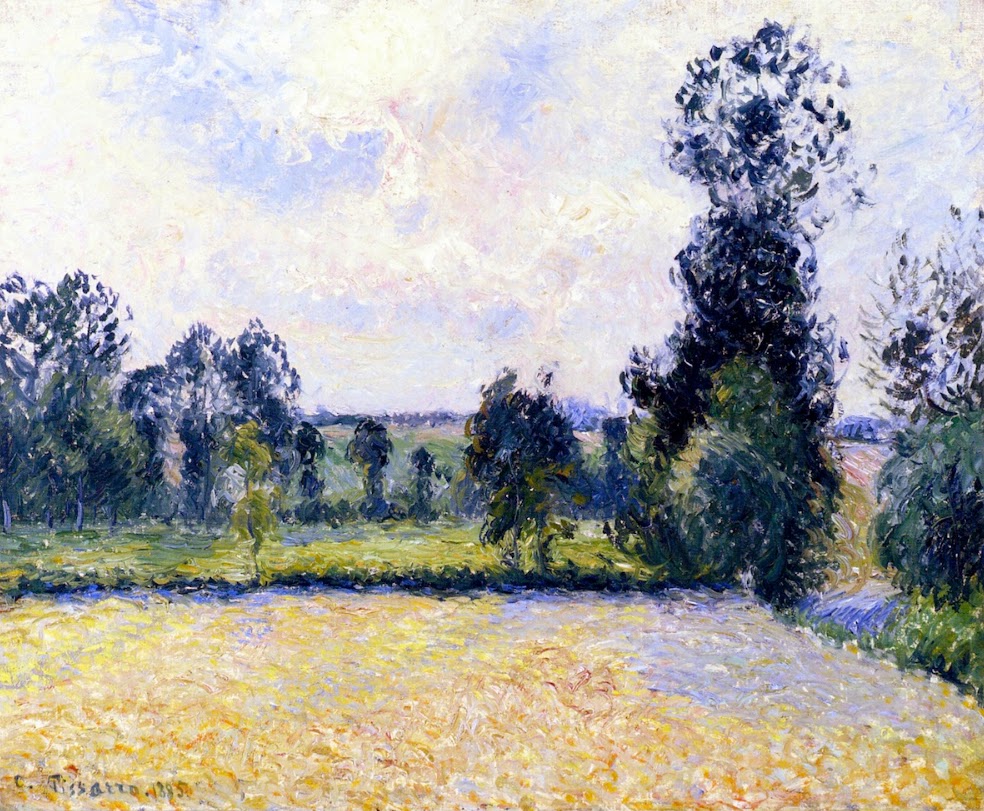
Field of Oats in Eragny (1885)


View of the Village of Bazincourt - 1889


Setting Sun and Fog Eragny, 1891


Poplars, Morning, Eragny - 1893


The Meadows at Eragny, Apple Tree, 1894


Tête de jeune fille de profil dite «la Rosa» (1896) 
oil on canvas 55.2 x 46.3 cm

The Boulevard Montmarte At Night, 1897

After spending six years painting in the rural setting of Éragny, Pissarro returned to Paris, where he produced several series of the “grands boulevards.” As Pissarro surveyed the view from his lodgings at the Grand Hôtel de Russie in early 1897, he marveled that not only could he “see down the whole length of the boulevards” but he had “almost a bird’s-eye view of carriages, omnibuses, people, between big trees, big houses that have to be set straight.” From February through April, he set out to record—in two views of the boulevard des Italiens to the right, and fourteen of the boulevard Montmartre to the left—the spectacle of urban life as it unfolded below his window.


Vue de Bazincourt en hiver, 1898


Avenue de l’Opera, Effect of Snow (1898)


Le Jardin Des Tuileries, Effet De Neige (1900)


Brouillard à l’Hermitage, Pontoise (1879)


Hyde Park, London (1890)


La Maison De Piette À Montfoucault (1874)


Landscape at Éragny (1890)

The painting Landscape at Éragny by Camille Pissarro was created in 1890. This artwork beautifully captures the rural charm of Éragny-sur-Epte, where Pissarro lived and worked during the later years of his life. His Impressionist style shines through in the delicate interplay of light and color


Self-Portrait, 1903

Camille Pissarro (1830–1903) was a Danish-French painter and a pivotal figure in the Impressionist and Post-Impressionist movements. Born on the island of St. Thomas in the Danish West Indies, Pissarro moved to Paris in 1855 to pursue his passion for art. He was deeply influenced by the works of Gustave Courbet and Jean-Baptiste-Camille Corot.

Pissarro is celebrated for his landscapes, urban scenes, and rural depictions, often capturing the effects of light and atmosphere with remarkable sensitivity. He was the only artist to exhibit in all eight Impressionist group exhibitions, showcasing his dedication to the movement. Later in his career, he experimented with Neo-Impressionism and pointillism, inspired by Georges Seurat.

Known as the "Father of Impressionism," Pissarro was a mentor to artists like Paul Cézanne and Paul Gauguin. His works remain iconic, reflecting his innovative approach to capturing the beauty of everyday life.