Showing posts with label Jack of Diamonds. Show all posts

Friday, April 4, 2014

Kazimir Malevich (Ukrainian 1878–1935)


Church (Vers 1905)
Huile sur carton Oil on cardboard 60.3 x 44 cm


Self Portrait (1908)
Oil on canvas, 27x26.8 cm, Tretyakov Gallery, Moscow


Portrait (vers 1910)
Gouache et huile sur carton Gouache and oil on cardboard 27.7 x 27.7 cm

Field


Reservist of the First Division (1914)


Two peasant women (circa 1928-30)


Maison rouge (Red house), 1932
Oil on canvas 63 x 55 cm.

Kazimir Severinovich Malevich (23 February 1879 – 15 May 1935) was a Russian painter and art theoretician. He was a pioneer of geometric abstract art and the originator of the avant-garde, Suprematist movement.
In 1915, Malevich laid down the foundations of Suprematism when he published his manifesto, "From Cubism to Suprematism". In 1915–1916 he worked with other Suprematist artists in a peasant/artisan co-operative in Skoptsi and Verbovka village. In 1916–1917 he participated in exhibitions of the Jack of Diamonds group in Moscow together with Nathan Altman, David Burliuk, Aleksandra Ekster and others. Famous examples of his Suprematist works include Black Square (1915) and White On White (1918).
from wikipedia

Tuesday, February 19, 2013

Rober Falk, Роберт Фальк, Russian

Robert Falk, Роберт Фальк (Russian, 1886-1958)

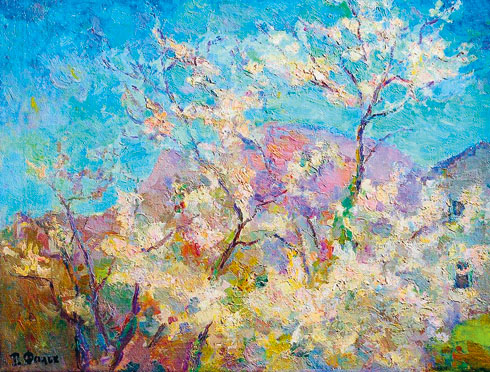
Spring in Crimea, 1938


Oak tree


 Brittany, Sun


View of a River (1934)


Bay in Balaklava, 1927


Cottage in the Woods


Boating on a River, 1935


Alupka, Crimea


A Fischus Plant, 1956


Two Women Sitting Among the Trees - 1930s

Falk was born in Moscow in 1886. In 1903 to 1904 he studied art in the studios of Konstantin Yuon and Ilya Mashkov, in 1905 to 1909 he studied at the Moscow School of Painting, Sculpture and Architecture with Konstantin Korovin and Valentin Serov.
In 1910 he was of the founders and the most active participants of artistic group Jack of Diamonds. The group considered Paul Cézanne the only painter worth following, and the rest of visual art to be too trivial and bourgeois. The distinctive feature of Falk's paintings of the time was sculpturing of the form using many layers of different paints.
In 1918-1928 Falk taught at VKhUTEMAS (State Higher Artistic and Technical Workshops). In 1928 Falk went on a supposedly short trip to France and refused to return; he worked in Paris until 1938, when he returned to Moscow.
After 1938 until his death in 1958 he worked in Moscow, most of the time in isolation. His works of that time were in neo-impressionist style with characteristic white-on-white colors (not unlike the later paintings of his teacher Valentin Serov).
During the Khrushchev Thaw he became popular among young painters and many considered Falk to be the main bridge between the traditions of the Russian and French Moderne of the beginning of 20th century and Russian avant-garde and the Russian avant-garde of the 1960s.