Friday, February 1, 2013

French Impressionism: Gustave Caillebotte

Gustave Caillebotte (French, 1848 – 1894)


Rue Halévy, From the Sixth Floor, 1878


The Parc Monceau, 1878


Rue Halevy, Balcony View, 1878. Oil on Canvas


Rising Road, 1881


The Plain at Gennevilliers, Group of Poplars, 1883


Fields, Plaine de Gennevilliers, Study in Yellow and Green  - circa 1884


La Plaine de Gennevilliers - 1888


Park in the Snow, Paris (1888)


Nasturtiums, 1892, Oil on canvas


The Briard Plain


Cliffs by the Sea at Trouville


Gustave Caillebotte et Bergère sur la place du Carrousel (1892)

Gustave Caillebotte (19 August 1848 – 21 February 1894) was a French painter, member and patron of the group of artists known as Impressionists, though he painted in a much more realistic manner than many other artists in the group. Caillebotte was noted for his early interest in photography as an art form.

German Expressionism: Hermann Max Pechstein

Flusslandschaft Um, 1907


Bridge over the Seine with Small Steamer (1908)


Hermann Max Pechstein - The Masked Woman (1910)


Melting Snow 1912


Charterhouse of Florence (1913)


Monterosso al mare


Lotte mit Kopftuch  - Lotte Wearing a Headscarf (1919) 
oil on canvas 88 x 62.5 cm


Portrait of a Woman, 1922


Bauernhuser mit Getreidefeld in Leba, 1922


The Sea Landscape (Meereslandschaft), 1924


Herbstabend (1927)


Waldweg (Forest Path) (1927) 
oil on canvas 52.5 x 62.4 cm


Cold Morning  (1927)


Autumn Sea (1933)


White Cloud (1949) 
oil on canvas 70 x 80 cm


Zerfallenes Haus


Südfranzösische Landschaft


Casas rojas


Girl in Red with a Parasol


Early Morning


Hauling the Boats


Hermann Max Pechstein (December 31, 1881 – June 29, 1955) was a German expressionist painter and printmaker, and a member of the Die Brücke group.
Beginning in 1933, Pechstein was vilified by the Nazis because of his art. 326 of his paintings were removed from German museums. 16 of his works were displayed in the Entartete Kunst (Degenerate Art) exhibition of 1937. During this time, Pechstein went into seclusion in rural Pomerania.

Ian Norris: Ainsdale Sands, Stormy Skies, Winter

Ainsdale Sands, Stormy Skies, Winter

Hungarian artists

Tamás Lossonczy (1904-2009)

Forming Life, 1967-68

Janos Tornyai 

Janos Tornyai - Clouding over the great hungarian plain


Janos Tornyai - View at Szentendre


Janos Tornyai - Woman with Goat


Edvi Illés Aladár (1870-1958) 


Edvi Illés Aladár - Landscape


Balla Béla (1882 - 1965)


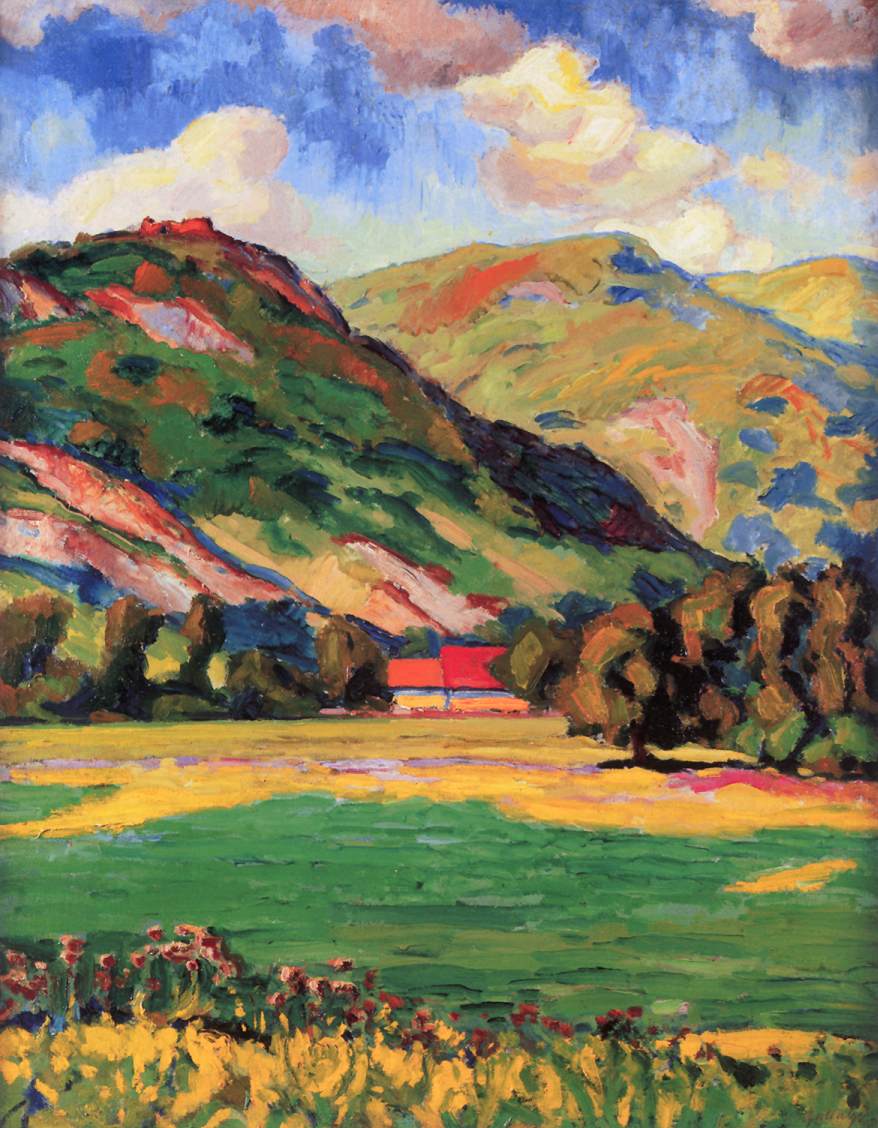
Balla Béla - Mountains


Balla Béla - Below the Flower Hill


Balla Béla - At the Lakeshore


 László Fülöp (1869 - 1937)

Landscape of Tyrol


János Deák (Hungarian, 1928 - )


House in sunshine

Francis Picabia, Port of Saint-Tropez


Port of Saint-Tropez, evening effect (1909)


Sedell, 1909


Star dancer and her school of dance, 1913


Sad Figure, 1913


Woman on green background (Femme sur Fond Vert), 1938


Woman with a Black Cravat, circa 1942


Portrait d’Yvette, c.1942-43

Avarice de la nature, 1948. Oil on card, 61.3 x 49.6 cm.

Francis Picabia (22 January 1879 – 30 November 1953) was a French painter, poet, and typographist, associated with Cubism, Abstract art, Dada and Surrealism.
In the beginning of his career, from 1903 to 1908, Picabia was influenced by the Impressionist paintings of Alfred Sisley. Little churches, lanes, roofs of Paris, riverbanks, wash houses, lanes, barges—these were his subject matter. Some however, began to question his sincerity and said he copied Sisley, or that his cathedrals looked like Monet, or that he painted like Signac. 
From 1909, he came under the influence of the Cubists and the Golden Section (Section d'Or).
In 1925, he returned to figurative painting, and during the 1930s became a close friend of Gertrude Stein. In the early 1940s he moved to the south of France, where his work took a surprising turn: he produced a series of paintings based on the nude glamour photos in French "girlie" magazines like Paris Sex-Appeal, in a garish style which appears to subvert traditional, academic nude painting. Some of these went to an Algerian merchant who sold them on, and so Picabia came to decorate brothels across North Africa under the Occupation.