Camille Pissarro (1830-1903)
“Blessed are they who see beautiful things in humble places where other people see nothing”
The Route to Versailles, Louveciennes (1869)
In 1869, Pissarro moved to No. 22 on the road to Versailles in the Paris suburb of Louvciennes. He was joined by Claude Monet who was then at nearby Saint Michel. In the winter of 1869/70, they both painted snow scenes showing this roadway from varying angles. The road to Versailles, on the north side of the village, afforded a superb view of Paris in the distance. The impressionists inherited from the Barbizon artists of a generation earlier an interest in the representation of winter, particularly, the challenge of the rendering of snow. Pissarro’s early works are relatively rare because the German troops who had been billeted in his house on the road to Versailles during the Franco-Prussian War had wrecked many of them.

La Maison De Piette À Montfoucault (1874)
De grosse Birnbaum in Montfoucault (1876)
Cultivated Land in Winter, a Man Carrying Fagots, 1877
Resting in the Woods at Pontoise, 1878
Near Rouen, 1883
Road at Eragny, Winter (1885)
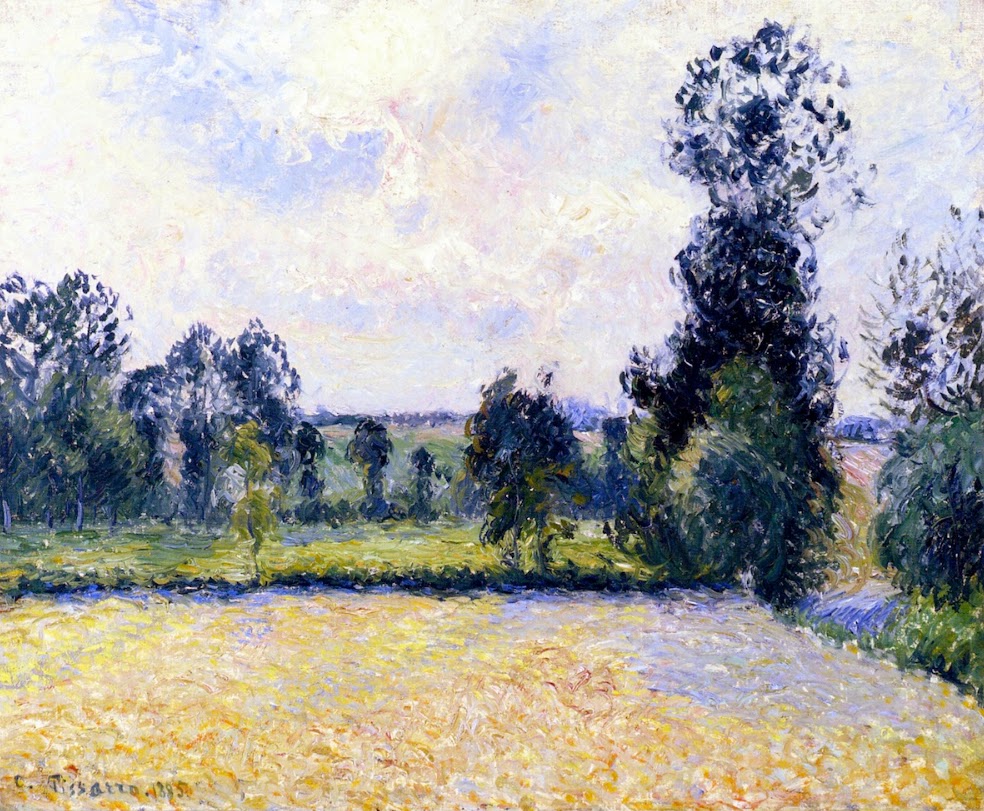
Field of Oats in Eragny (1885)
View of the Village of Bazincourt - 1889
Setting Sun and Fog Eragny, 1891
Poplars, Morning, Eragny - 1893
The Meadows at Eragny, Apple Tree, 1894
Tête de jeune fille de profil dite «la Rosa» (1896)
oil on canvas 55.2 x 46.3 cm
The Boulevard Montmarte At Night, 1897
After spending six years painting in the rural setting of Éragny, Pissarro returned to Paris, where he produced several series of the “grands boulevards.” As Pissarro surveyed the view from his lodgings at the Grand Hôtel de Russie in early 1897, he marveled that not only could he “see down the whole length of the boulevards” but he had “almost a bird’s-eye view of carriages, omnibuses, people, between big trees, big houses that have to be set straight.” From February through April, he set out to record—in two views of the boulevard des Italiens to the right, and fourteen of the boulevard Montmartre to the left—the spectacle of urban life as it unfolded below his window.
Vue de Bazincourt en hiver, 1898
Avenue de l’Opera, Effect of Snow (1898)
Le Jardin Des Tuileries, Effet De Neige (1900)
Brouillard à l’Hermitage, Pontoise (1879)
Hyde Park, London (1890)
La Maison De Piette À Montfoucault (1874)
Landscape at Éragny (1890)
The painting Landscape at Éragny by Camille Pissarro was created in 1890. This artwork beautifully captures the rural charm of Éragny-sur-Epte, where Pissarro lived and worked during the later years of his life. His Impressionist style shines through in the delicate interplay of light and color
Self-Portrait, 1903
Camille Pissarro (1830–1903) was a Danish-French painter and a pivotal figure in the Impressionist and Post-Impressionist movements. Born on the island of St. Thomas in the Danish West Indies, Pissarro moved to Paris in 1855 to pursue his passion for art. He was deeply influenced by the works of Gustave Courbet and Jean-Baptiste-Camille Corot.
Pissarro is celebrated for his landscapes, urban scenes, and rural depictions, often capturing the effects of light and atmosphere with remarkable sensitivity. He was the only artist to exhibit in all eight Impressionist group exhibitions, showcasing his dedication to the movement. Later in his career, he experimented with Neo-Impressionism and pointillism, inspired by Georges Seurat.
Known as the "Father of Impressionism," Pissarro was a mentor to artists like Paul Cézanne and Paul Gauguin. His works remain iconic, reflecting his innovative approach to capturing the beauty of everyday life.

.jpg)


.jpg)


%20oil%20on%20canvas%2055.2%20x%2046.3%20cm.jpg)


+-+Self-Portrait,+1903.jpg)